Book Marketing for 2025 and 2026
Note: This video is one of three videos created by NotebookLM by Google using the 10 Ways to Market Your Books report generated by the Comet browser from Perplexity AI as input. I’ll share the other two videos in the next few days. It’s interesting to hear how each of the videos approach the 10 Ways report by featuring the top 3 ways. Obviously Google and YouTube favor top 3 videos versus top 10 videos.
Here is the transcript from the video (with my comments):
So if you’re an author wondering how on earth to make your book stand out in 2025 and 2026, you are in the right place. We’re about to give you the blueprint. We’re going way beyond just a simple list of tips today to give you a real strategic book marketing framework for success.
It’s the one that keeps authors up at night. The book market today feels like this huge stormy ocean, and it’s just so easy for your book to feel like a tiny boat lost at sea. So the real question is, how do you build a lighthouse that guides readers right to you?
We’re gonna tackle the big book marketing challenge of 2026. Then we’ll dive into your digital footprint, talk about growing your author community, master direct outreach, and finally pull it all together into a balanced marketing plan. Succeeding in 2025 and 2026 isn’t about just throwing a bunch of marketing spaghetti at the wall and hoping something sticks.
It’s about creating a cohesive plan where every single thing you do supports everything else. We’re moving past a random checklist and into a real strategy. The secret to this strategic plan is a pretty simple framework.
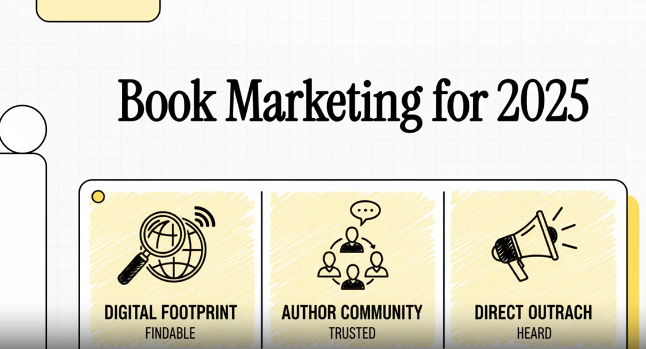
The Three Legs of Book Marketing
Think of it like a three-legged stool. Why a stool? Well, because if you take away even one of those legs, the whole thing just topples over. So what are these three pillars that are going to support your entire author career? Three, that’s the magic number. It’s the key that turns all that overwhelming chaos of book marketing into a simple, powerful, and totally manageable system.
Ready to see what they are? Let’s break them down.
1. Digital Footprint – Be Findable Online
This one tackles probably the most painful problem for any author, invisibility. It’s that fear that you’ve poured your heart and soul into a brilliant book, but no one will ever find it. This pillar, your digital footprint, is all about building a foundation that makes you absolutely impossible to ignore.
Now, a huge part of this is social media, but the secret is focus. Don’t try to be everywhere. Instead of just posting, buy my book, share a photo of the coffee shop where you wrote your favorite chapter, or a short video about the real person who inspired a character. It’s those small, authentic glimpses that turn followers into actual fans.
John’s Comments: Social media is an important facet of any marketing. Choose one or two social media that you are comfortable using and which best fit what you do best (create graphics, use words, make videos, etc.). One important consideration beyond your comfort: What social media does your target market use? The top social media in today’s world are Instagram, TikTok, and YouTube.
While social media is like renting a little spot on someone else’s property, your author website, that’s the land you own. It’s your home base, your headquarters. By optimizing it for search engines, you’re not just putting up a sign, you’re building this powerful permanent magnet that pulls readers to you 24-7.
These two points really capture the two sides of visibility perfectly. Think of it like this. Organic reach from your website and social media, that’s like planting a tree. It takes time, right, but it grows strong and gives you shade for years.
John’s Comments: Every author should have a website or a Substack profile or something similar to call your home on the internet. While Substack, Medium, or similar platforms can offer great exposure, ultimately your best bet is to own your website URL and host it on a website hosting site such as Ionos.com or Bluehost.
Paid ads are like a rocket launch, a powerful targeted burst that gets you into orbit really fast. A truly effective plan needs both.
John’s Comments: Paid ads have three great advantages over organic search and social media. First, you can implement the ads immediately rather than waiting for the growth of visitors or followers. Second, you can test the ads at low cost until you find what wording, images, etc. actually work. Third, once you find what works, you can run ad after ad generating consistent sales and income.
Some of the most promising ad platforms for book authors are Instagram, YouTube, Rumble, Facebook, and Pinterest. You can also test ads on Amazon or any other sales platforms where your books are featured.
Alright, so people can find you. That’s a huge step. But what happens next?
2. Author Community – Strategies to Build Trust
That’s where our second pillar comes in. It’s not enough just to be found. You have to be trusted. And that is all about building a real human connection with your readers. One of the biggest shortcuts to building trust is to borrow it from people who already have it.
When you partner with a book blogger or a book talk influencer, you’re not just getting your book in front of their followers, you’re getting a warm introduction from a friend they already trust. And that kind of authentic endorsement is priceless.
John’s Comments: A great procedure to follow is to connect with top bloggers, podcasters, video makers, and other influencers is outlined in detail in my article on The I-Don’t-Have-Any-Time Hour-a-Day Book Marketing Plan. It describes how to make connections with top influencers.
If your author platform is a house, your email list is the foundation. Social media platforms can change their algorithms overnight and, poof, your reach can disappear. But your email list, that’s yours. It’s a direct line to your most loyal fans, a community you can connect with for years to come.
John’s Comments: I’m now using the Substack platform as my email list developer and sender as well as my podcast platform. It’s free to use. And it allows you to have two levels of subscribers: free and paid. I like that feature. Note: paid subscribers is how Substack earns it’s income (as a small portion of your income).
Be consistent in sending out emails to your list. Once or twice a week on the same days—that’s the most effective way to get people to watch for your emails and read them. That builds trust. Personally, I’m bad at this consistency. So I send out emails and podcast episodes in streaks. But I do know that consistent emails are better.
Think about the last time you bought something online. Did you just click buy or did you scroll down and see what other people were saying? Reviews are the digital version of a friend leaning over and saying, you have to read this book. They are pure gold.
John’s Comments: Ask for reviews on Amazon. Ask for video reviews on Amazon. You can ask for those reviews via your Amazon sales copy and via Amazon ads. You can also ask for reviews and interviews from book bloggers, video bloggers, and podcasters.
Online reviews are easier to get than print reviews in newspapers (which review so few books now) and magazines. Target your requests to those bloggers and media that feature content similar to your book and have audiences you want to reach.
Finally, let’s talk about the power of working together. The author world can feel competitive sometimes, but it is also so incredibly supportive. Partnering with other authors in your genre for things like newsletter swaps isn’t just a smart marketing move. It’s a way to build community, share audiences, and lift each other up. It’s the ultimate win-win. So. you’re findable and you’re trusted. You’ve built the engine.
John’s Comments: I’ve always recommended working with other authors, even authors who might seem like competitors. You will sell more books together than you will ever sell on your own. Both of you will. To connect with other book authors, check out my article on The I-Don’t-Have-Any-Time Hour-a-Day Book Marketing Plan.
3. Direct Outreach – Ensure You Are Heard
Our third and final pillar is all about being proactive, about taking your message directly to the people who need to hear it and making sure you’re not just a whisper in the wind, but a voice they can’t ignore.
This is where you stop waiting for readers to come to you and you start going to them. Actively reaching out to podcasters and bloggers, it’s not about being pushy. It’s about being generous with your story and your expertise. And for those of you who are tired of that daily social media grind, this is your escape hatch.
John’s Comments: Duplicated advice: A great procedure to follow is to connect with top bloggers, podcasters, video makers, and other influencers is outlined in detail in my article on The I-Don’t-Have-Any-Time Hour-a-Day Book Marketing Plan. It describes how to make connections with top influencers.
In a world of screens and algorithms, there’s a special kind of magic in showing up in person. A handshake, a shared laugh, a signed copy of your book, these are the moments that create a deep, lasting connection. Digital is great for reach, but in-person events are where you turn readers into passionate advocates for life.
John’s Comments: In the world of book marketing, there’s nothing more effective for marketing books than to speak live to your potential audience: at bookstores, at libraries, at conferences, at conventions, at trade shows, or even online. When I speak at conferences and conventions, I always try to spend time with the attendees as well. I always learn as much from them as they learn from me. And that personal time is a great way to make a connection and, often, a sale.
Book Marketing Plan – Conclusion
So we have these three powerful pillars, but here’s the crucial insight. They’re not separate strategies. They are a system. The real magic happens when you integrate all three, creating a marketing plan that becomes this self-reinforcing engine for growth.
Your digital footprint makes you findable, your author community builds trust, and your direct outreach makes sure you’re heard. See how they all feed into each other? A great podcast interview sends people to your website where they sign up for your email list. It’s a beautiful, powerful cycle.
Which one of these pillars, being findable, being trusted, or being heard, is the weakest link in your chain right now? Because that’s your starting point. That’s where you can make the biggest impact. A balanced plan isn’t just about selling more books. It’s about building a sustainable, fulfilling career. Now go build your stool.